
Clovis Concrete Crew builds poured concrete retaining walls for homes in Clovis and the foothill communities east of town. Clovis itself sits on a nearly flat alluvial fan, so most walls inside city limits are short: raised planters, a step between a patio and the yard, a sunken pool area, or a wall along a property line where one lot sits higher than the next. Head up toward Prather, Tollhouse, and Auberry and the grades get real, and so do the walls.
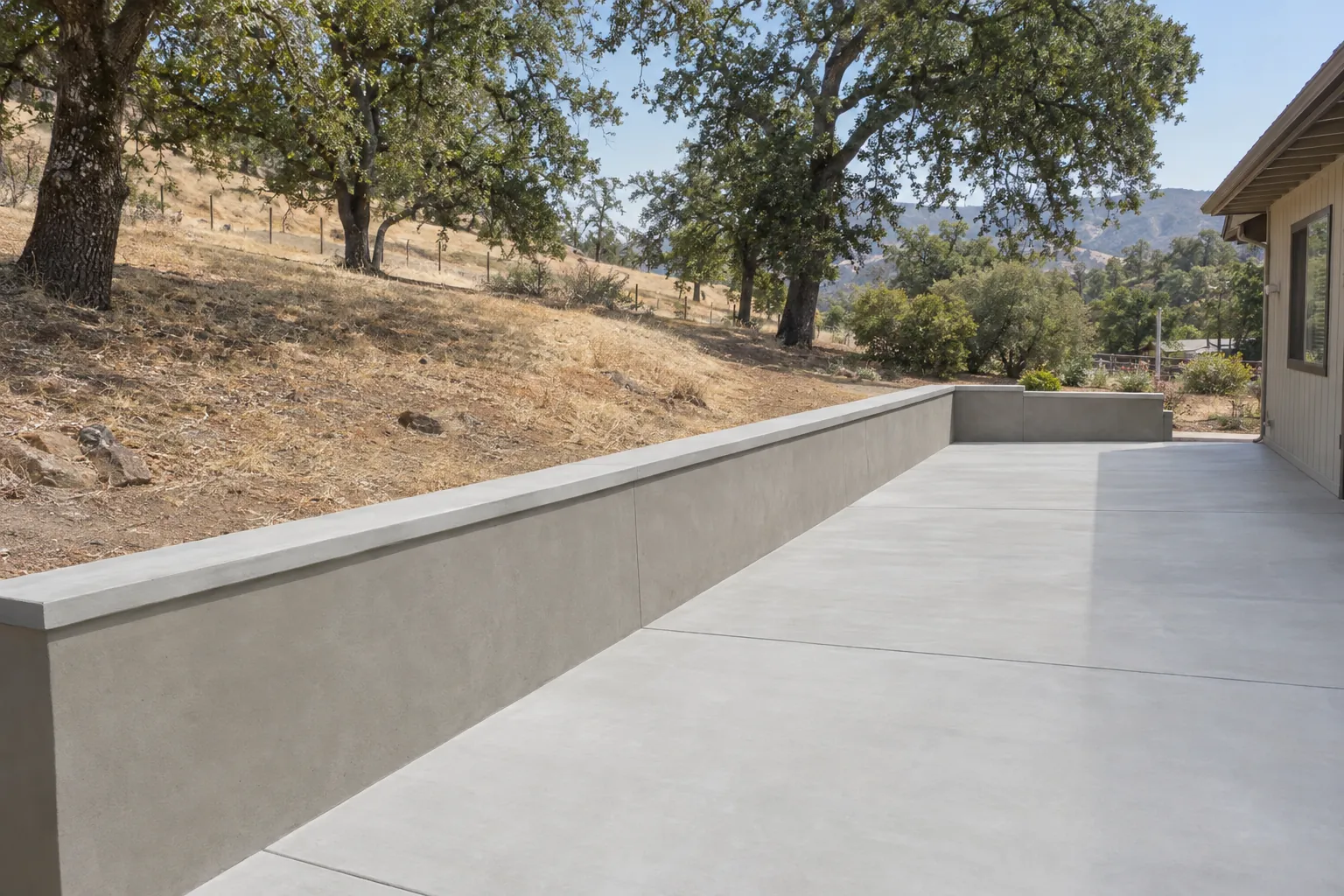
Where Clovis Homeowners Need Retaining Walls
- Backyard grade changes for a pool, sport court, or patio that needs a level pad
- Raised planter and seating walls around patios and outdoor kitchens
- Side yards where an RV or boat pad has to be cut into a slope
- Foothill driveways on lots climbing toward the Sierra
- Property-line walls between lots built at different heights
How We Build a Poured Concrete Retaining Wall
Footing
Every wall starts with a reinforced concrete footing, wider than the wall itself, with a toe that resists sliding and overturning. In much of the Clovis and Fresno area, a cemented hardpan sits close to the surface. The San Joaquin soil series puts it about 20 to 40 inches down. When a footing trench hits it, the hardpan has to be broken out with a breaker or rock bit. Hardpan can be as hard as concrete, so we plan for it in the quote instead of surprising you with it later.
Reinforcement
Vertical rebar ties the stem of the wall into the footing, with horizontal bars running the length. Bar size and spacing come from the wall height, the soil, and whatever sits above the wall.
Stem wall and forms
Forms are set plumb and braced, then the wall is poured and consolidated. Finish options include a smooth form face, a board-formed texture, a stucco finish to match the house, or a cap for seating.
Drainage
Water is what pushes walls over. Behind every wall we place drain rock, filter fabric, and a perforated drain pipe with an outlet, plus weep holes where they make sense. Drainage matters even more here because water can perch on top of the hardpan instead of soaking away.
Height, Permits, and Engineering
Under the California building code, a retaining wall more than 4 feet tall, measured from the bottom of the footing to the top of the wall, needs a building permit. So does a wall of any height holding up a surcharge such as a driveway, a slope, or a structure above it. Those walls typically need an engineered design. We handle the drawings and permits with the City of Clovis or Fresno County, depending on your address, and call USA North 811 to mark buried utilities before digging.
Poured Concrete vs. Block Walls
Block retaining walls are common and work well for many jobs. Poured concrete makes sense when you want one continuous monolithic wall, a smooth or board-formed modern look, a wall that doubles as a bench or planter, or a wall designed to carry a load above it. We'll talk through both when we look at your lot.