
Clovis Concrete Crew builds new concrete pool decks and replaces worn ones for backyard pools across Clovis. In a place where summer highs pass 100 degrees for weeks at a time, a pool deck isn't just a frame around the water. It's the surface your family crosses barefoot all afternoon, so color, texture, and finish matter as much as strength.
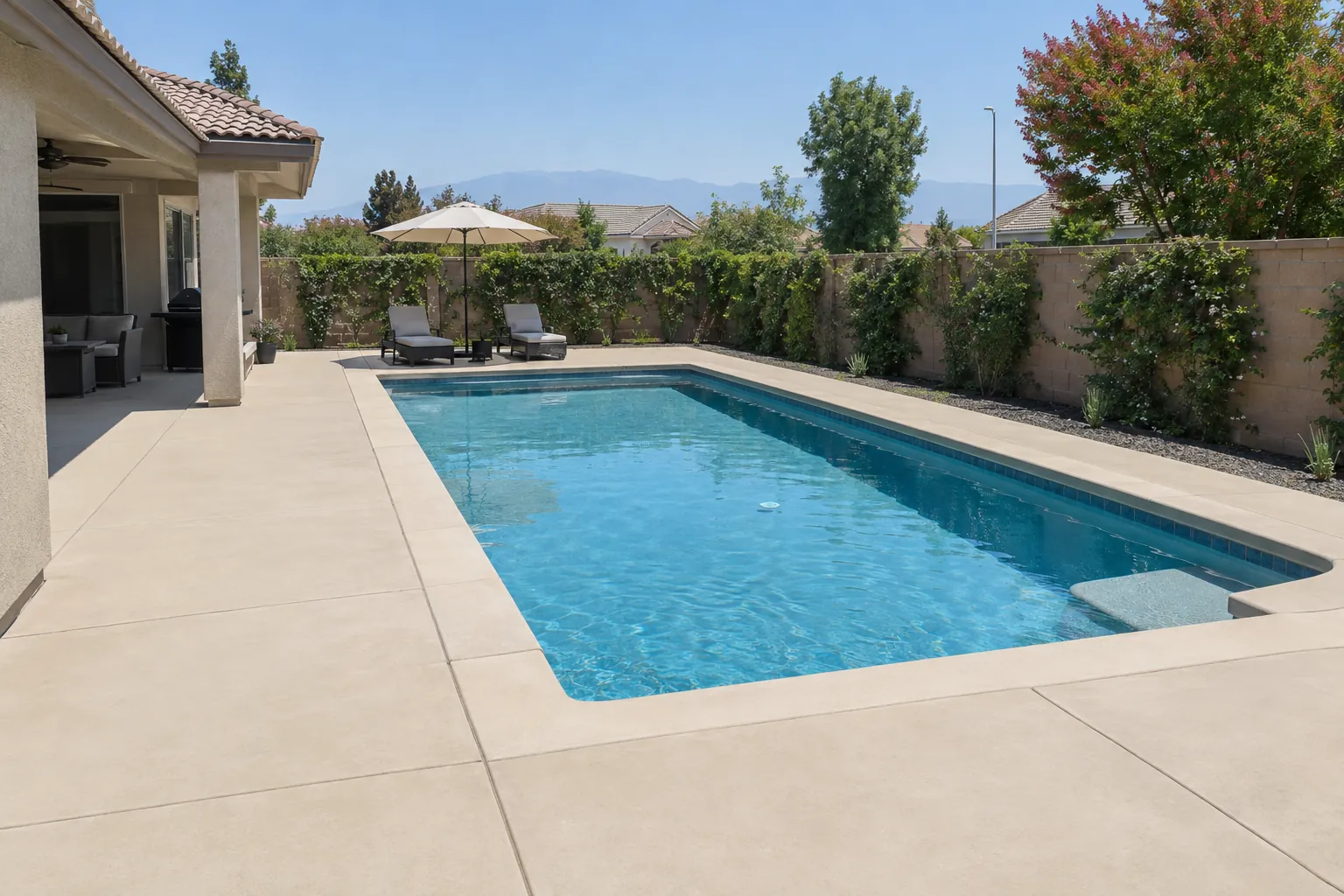
Choosing a Deck Finish for Clovis Sun
Light colors
Dark concrete absorbs far more sunlight than light concrete, and you feel it underfoot. For pool decks we steer most homeowners toward light grays, buffs, and sandy tans, either as integral color mixed into the concrete or as a coating on top.
Salt finish
Rock salt is pressed into the fresh surface and washed out after it sets, leaving small pits. It gives grip for wet feet and a soft, natural look, and it's one of the most common pool deck finishes in hot climates.
Broom and light-broom finishes
A fine broom texture is affordable and slip-resistant. It's a little rougher on feet than a salt finish, so we keep the broom light around the pool.
Cool-deck coatings
A textured acrylic or cementitious coating sprayed or troweled over the slab, usually in a light color. It's popular in hot climates because it feels cooler and softer underfoot than bare concrete, and it can be recoated when it wears. See resurfacing and sealing if you want to coat an existing deck.
Stamped patterns
Stamped stone or slate textures look rich, but deep grooves and dark release colors can hold heat. If you want stamped, we suggest a lighter base color and a pattern with a gentle texture. Our pool deck materials guide compares every option, including pavers.
How a Pool Deck Goes Together
Base and slope
We compact the soil, place Class II aggregate base, and set forms so the deck slopes away from the pool, typically about 1/8 to 1/4 inch per foot, toward planters, lawn, or deck drains. Water and pool chemicals should never run back into the pool or toward the house.
Expansion joints at the coping
The joint between the deck and the pool coping is the most important detail on the job. A flexible expansion joint there lets the deck and the pool shell move independently. When it's missing or filled with hard grout, the deck can push on the coping and crack tile or the bond beam. We finish it with a UV-resistant joint sealant.
Thickness and steel
Pool decks are usually 4 inches thick with rebar or mesh. Where the deck carries a heavy planter, an outdoor kitchen, or a shade structure footing, we thicken that area.
Hardpan and drainage
Clovis soils often have a cemented hardpan not far below the surface, and water can sit on top of it. Around a pool, that matters. Splash-out and irrigation need somewhere to go, so we plan deck drains or slope to areas that can take the water.
Timing the Pour Around the Heat
A pool deck is a large, thin, sun-exposed slab, the kind most likely to dry too fast in summer. We start at dawn, dampen the base, finish quickly, and cure the slab with water or a curing compound. Joints are cut the same day.
Replacing an Old Deck
Common signs a deck is done: lifted or sunken sections, a wide gap at the coping, cracks running through many panels, or a coating that has peeled down to bare concrete. We break out the old deck carefully around the coping, haul it to a recycler, and pour new. If the deck is sound but ugly, a coating may be all it needs.