
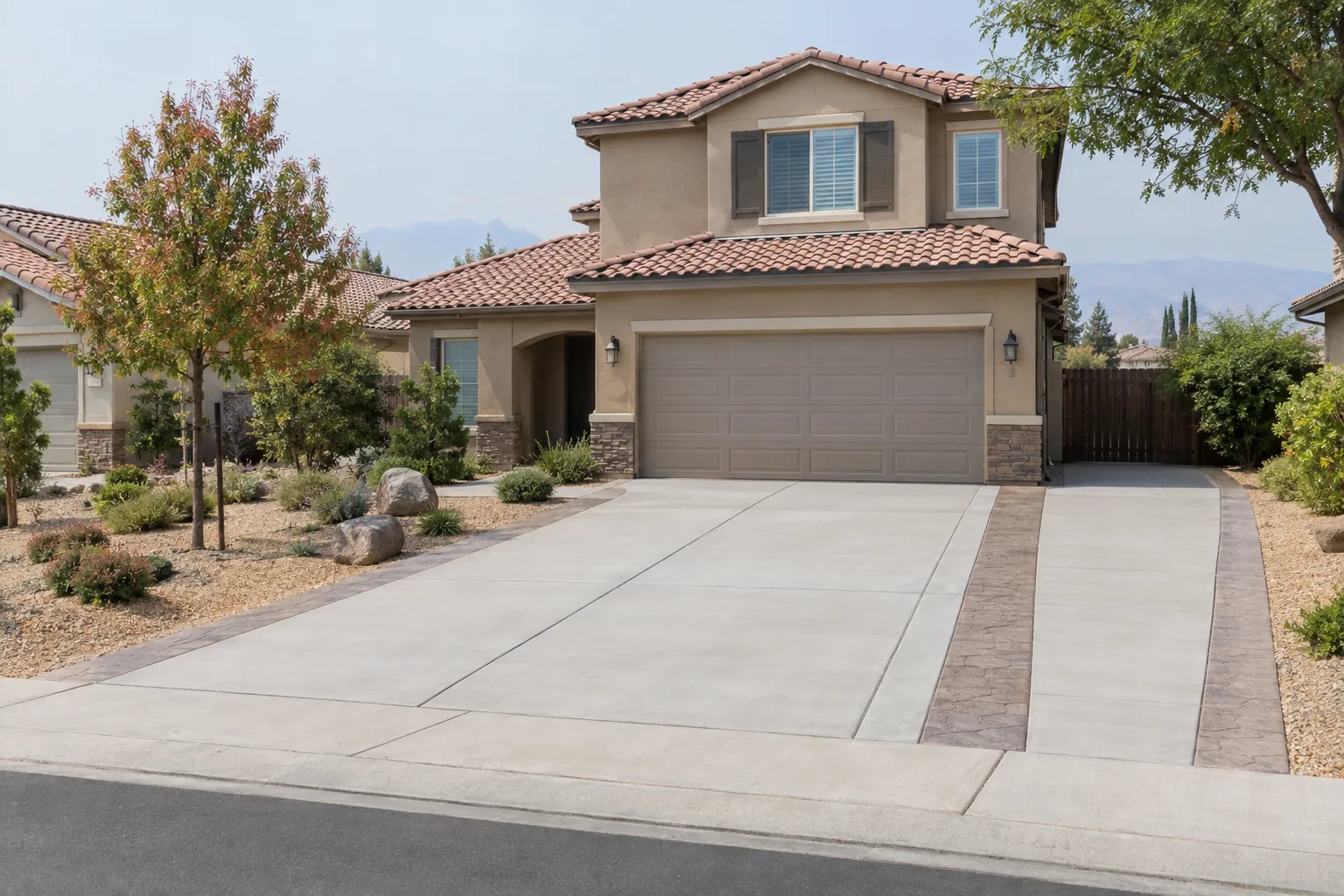
Clovis Concrete Crew pours new concrete driveways, replaces worn-out ones, and widens driveways that no longer fit the household, across Clovis from Old Town to Loma Vista and Heritage Grove. A driveway here has to handle two things most of the country doesn't think about: summer slab temperatures that can cook a fresh pour, and a cemented hardpan that sometimes sits a couple of feet below the lawn.
What Goes Into a Clovis Concrete Driveway
Subgrade and base
We strip the sod and topsoil, then grade and compact the native soil. On top of that goes Class II aggregate base, usually about 4 inches, compacted with a plate compactor or roller. Where a soil test or the dig shows salty or alkali ground, we discuss a sulfate-resistant mix before ordering concrete.
Thickness
- Cars, SUVs, and pickups: 4 inches is the common residential standard - Boats, trailers, and RVs: 5 to 6 inches, with thickened edges where heavy tires roll on and off - The approach at the street: built to the City of Clovis standard drawing for that section
Reinforcement and joints
Most driveways get #3 or #4 rebar set on chairs so it stays in the middle of the slab, or welded wire mesh. Control joints go in at roughly 2 to 3 times the slab thickness in feet, so a 4 inch driveway is jointed every 8 to 12 feet. Expansion joint material goes where the driveway meets the garage slab, walks, and the street approach.
Mix
Residential driveways in the Valley are commonly poured with a 3,000 to 4,000 psi mix. On hot days the ready-mix plant can add a set retarder so the crew has time to finish before the concrete stiffens.
Pouring in the Heat
From June through mid-September, Fresno County regularly sees highs of 100 degrees or more. Concrete placed in the afternoon in that heat dries from the top too fast, which leads to plastic shrinkage cracks and a weak, dusty surface. That's why our driveway pours start at first light:
- The base is dampened just before the pour so it doesn't pull water out of the concrete.
- The truck arrives early, while the air and the ground are still cool.
- Finishing happens quickly, with an evaporation retarder sprayed on if the surface starts drying ahead of the crew.
- Joints are saw-cut as soon as the slab can take the blade without raveling.
- The slab is wet-cured or sealed with a curing compound so it keeps its moisture for the first days.
Our summer concrete guide goes deeper on what a careful crew does on a 100 degree day.
When We Hit Hardpan
Much of the Clovis and Fresno area sits on a cemented hardpan, a layer that can be nearly as hard as concrete itself. Driveways rarely need to dig that deep, but grading for a sloped approach, a thickened RV edge, or a drain line can hit it. When that happens we break or rip through it rather than pouring over a soft pocket on top of it, because water that perches on hardpan softens the soil above.
Replacing an Old Driveway
Driveways in older parts of Clovis were often poured thinner and without steel. If yours is broken into many pieces, sinking, or has spalled over a large area, replacement is usually the better value. We saw-cut the edges, break out the old slab, haul it to a recycler, rework the base, and pour new. If only a few panels are bad, see concrete repair for cutting out and replacing individual sections.
Extensions and Side Parking
A lot of Clovis families need more room: a third car, a work truck, or a boat. We widen driveways with dowels drilled into the existing slab, or an expansion joint where the two pours meet. For a boat or trailer along the side of the house, an RV pad built thicker than the driveway is usually the right call.
Finishes
Broom finish is standard and gives good traction. Many homeowners add a stamped or colored border, or upgrade the whole surface. See stamped and decorative concrete for patterns and colors that hold up in the sun.
Permits for the Driveway Approach
The approach, the part between your property line and the street, sits in the public right-of-way. In Clovis, work there needs an encroachment permit, with a construction drawing and a traffic control plan, and the finished approach is built to City standard specifications. We handle the submittal. Addresses in Fresno or unincorporated Fresno County go through those agencies instead.